
Forklift batteries are essential for electric industrial trucks – and their production is resource- and energy-intensive. However, many batteries are recycled too early, even though they can retain their performance for several years with proper reconditioning. Refurbished batteries extend the service life of existing resources, reduce CO₂ emissions, and lower operating costs – without compromising safety or quality.
What is the difference between used and reconditioned batteries?
Used batteries are untested second-life systems whose residual capacity can fluctuate significantly. Reconditioned batteries, on the other hand, undergo a complete technical reconditioning process: discharge, desulfation, recalibration, equalization charge, and cell testing . Voltage, internal resistance, and electrolyte density are precisely measured. After completion of the reconditioning process, they typically reach 70–90% of their original nominal capacity and are delivered with a capacity certificate confirming a guaranteed residual capacity of ≥ 70% for 12 months . Reconditioning is carried out according to ISO 9001-certified quality assurance procedures .
How do regenerated batteries contribute to resource conservation?
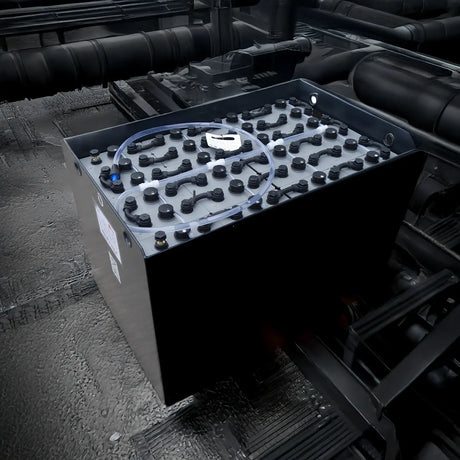
Each regeneration saves significant amounts of primary raw materials. A typical 48 V/775 Ah lead-acid battery weighs approximately 900 kg . Regeneration requires approximately 40% less lead and approximately 30% less sulfuric acid than new production. In lithium-ion systems, module rebalancing and cell repair can result in material savings of as much as 30–40% . Thus, every regenerated battery actively contributes to reducing global raw material consumption.
How much CO₂ does regeneration actually save?
Based on current lifecycle analyses, the emission factor for battery production is approximately 220 g CO₂ per kWh . For a 48 V/775 Ah battery with approximately 35 kWh of energy content, this results in total emissions of approximately 7.7 t CO₂ during new production. Regeneration reduces this value by 40–60% , or approximately 330–440 kg CO₂ per battery cycle. This saving roughly corresponds to the annual CO₂ emissions of a mid-size car traveling 2,000 km—a significant contribution to sustainable logistics.
How reliable are regenerated batteries in operation?
Refurbished batteries reach 70–90% of their original capacity during normal operation and maintain a stable voltage throughout the entire discharge cycle. All systems undergo electrochemical performance testing prior to delivery and are issued with a capacity certificate documenting minimum values and the test date. The procedures include, among others:
- Desulfation and realkalization according to ISO 9001-certified processes
- Equalizing charge with current reduction to 3% of the bulk current
- Measurement of cell voltage, internal resistance and electrolyte density
The guaranteed minimum capacity is ≥ 70% after 12 months – with annual re-testing to ensure performance stability.
How economical are regenerated batteries?
Refurbished batteries offer cost savings of approximately 30–50% compared to new systems, depending on capacity and type. The payback period is on average 6–12 months , based on an energy price of €0.15/kWh and typical three-shift operation. Lower disposal costs and an extended service life further increase the total cost of ownership (TCO) of ownership.
How often can batteries be regenerated?
Lead-acid batteries can be regenerated an average of 2–3 times —with optimal care and regular maintenance, even up to four cycles . After each reconditioning, the battery is retested and receives a certificate with documented capacity. This extends the effective service life of a battery by several years before it enters the closed lead recycling cycle with a recovery rate of over 99%.
Conclusion
Refurbished forklift batteries are technically tested, ecologically sound, and economically attractive. They reduce CO₂ emissions by 40–60% , reduce raw material consumption by up to 40%, and halve acquisition costs – with a guaranteed residual capacity of ≥ 70% over 12 months. With 2–3 possible regeneration cycles per battery, the material cycle is significantly extended, the environment is protected, and operations are made more sustainable. A significant contribution to future-proof and resource-efficient intralogistics.
HK Handels GmbH – your certified partner for regenerated forklift batteries with tested quality, CO₂ transparency, and a guarantee.