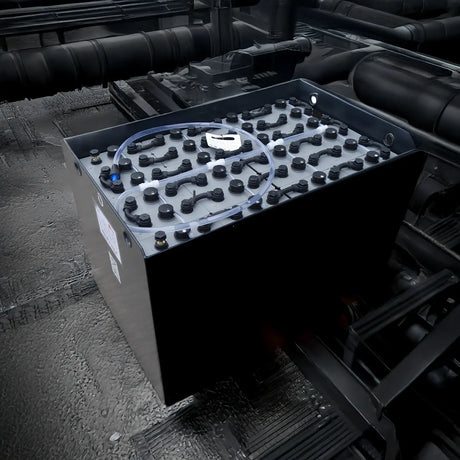

Regularly checking and topping up water is one of the most important maintenance tasks for lead-acid forklift batteries . Mistakes or neglect not only lead to loss of performance and shortened service life , but can also seriously compromise operational safety .
This guide will tell you when and how to correctly refill water, what quality is required, and how to properly test and maintain Aquamatic systems .
Do you have to refill water in every forklift battery?
No – it depends on the battery type:
- Lead-acid batteries (wet batteries): Must be regularly filled with distilled or demineralized water, as water components evaporate during charging.
- VRLA batteries (Gel & AGM): Closed, valve-regulated systems – no refilling allowed or required.
- Lithium-ion batteries: Maintenance-free, no water required.
Conclusion: Only conventional lead-acid traction batteries need to be checked regularly and filled with water that complies with standards.
When should you refill water – before or after charging?
Basic rule: Water is only refilled after the charging process is complete .
Why? During charging, the battery heats up, the electrolyte expands, and water evaporates. If you refill before charging , the electrolyte may overflow when it heats up, with risks such as corrosion, short circuits and loss of capacity .
Which water can be used?
Only distilled or demineralized water that complies with DIN EN ISO 3696 Type II or III is permitted. Tap water contains limescale and minerals, causing deposits and voltage losses.
- Conductivity: ≤ 10 µS/cm
- Free from salts, lime and organic substances
- Refilling temperature: 20 – 30 °C (hand-warm to avoid thermal shock and gassing)
Tip: Only use industrial-grade battery water with documented conductivity – ideal for fleet operations and multi-shift systems.
How do you refill water correctly?
Step-by-step procedure:
- Fully charge the battery and allow it to cool to room temperature.
- Personal protective equipment (PPE): Wear acid-resistant gloves, safety goggles, face shield, apron and acid-resistant shoe covers.
- Carefully open the cell lid.
- Check electrolyte level – after cooling , 10–15 mm above the plates .
- Only refill with distilled water up to the mark when necessary – never overfill.
- Close the cover, clean the outside of the battery and check the seals.
- Measure the electrolyte density with a hydrometer (target value ≈ 1.28 kg/l) and document it in the maintenance log .
How often should you refill?
Check the water level regularly – ideally after:
- 50 charging cycles or
- 200 operating hours
An operating hours counter or cycle counter makes tracking easier. Keep a maintenance log with the date, fill level, density value, and any special observations. This will help you identify any deviations or cell problems early on.
Consequences of too low water levels
A permanently low electrolyte level leads to serious damage:
- Sulfation: exposed plates crystallize and permanently lose active mass.
- Plates dry-out: drying out of the active layer, irreversible capacity loss.
- Overheating: uneven internal resistance and thermal damage.
- Cell failure: short circuit or total failure of individual cells.
Aquamatic – how to use and maintain the automatic refill system correctly
An Aquamatic system automatically fills all battery cells via a network of hoses and valves. This ensures consistent and precise water refills – ideal for large batteries or multi-shift operation.
Advantages
- Uniform fill levels in all cells
- No contact with electrolyte
- Time savings and greater occupational safety
- Avoiding overflow and underfilling
Maintenance of the Aquamatic system
- Carry out a leak and function test at least once a year with a test pressure of approximately 1.2 bar .
- Clean hoses, valves and filters to prevent germs and limescale deposits .
- Replace defective or hardened pipes immediately.
Emergency measures in case of electrolyte leakage
- Immediately neutralize any leaked electrolyte with sodium carbonate (soda) .
- Collect residues with absorbent material and store in acid-resistant containers .
- Disposal in accordance with hazardous substances regulations (ADR Class 8) .
- Wear personal protective equipment – especially face protection and acid-resistant gloves.
Conclusion: Diligence pays off
Correctly refilling water determines the performance, lifespan and safety of your lead-acid forklift battery. Only water according to DIN EN ISO 3696 , the correct fill level (10–15 mm above the plates) and regular checks prevent expensive damage caused by sulfation or dry-out.
With the Aquamatic system , hydrometer measurement , leak testing and documented maintenance, you ensure consistently high battery efficiency. HK Handels GmbH supports you with suitable accessories, standard-compliant battery water and service for treatment, retrofitting and maintenance.