
Forklift batteries are the heart of electrically powered industrial trucks. They determine performance, range, and efficiency – and thus directly affect operating costs. Different systems are used depending on the technology, application profile, and budget. In this article, you'll learn about the different battery types , how they differ , and which solution is most beneficial for your business in the long term .
Which types of batteries are used in forklifts?
Basically, four main categories can be distinguished:
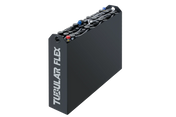
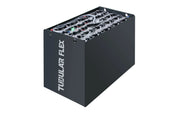
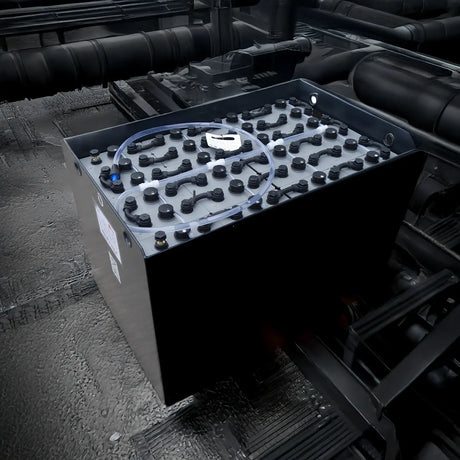
- Lead-acid batteries – classic wet cells with liquid sulfuric acid electrolyte
- Gel batteries (VRLA) – Silica gel binds the electrolyte, completely maintenance-free
- AGM batteries (Absorbent Glass Mat) – glass fiber mat absorbs the electrolyte, robust and vibration-resistant
- Lithium-ion batteries – modern cells with liquid organic electrolytes (solid electrolyte only in special LiFePO₄ gel systems)
Comparison of common forklift battery types
| type | technology | Cycles (C5) | Efficiency | Charging time (0–100%) | Energy density (Wh/kg) | Advantages | Disadvantages | Typical use |
|---|---|---|---|---|---|---|---|---|
| Lead-acid | Liquid sulfuric acid electrolyte | ≈ 1 200 (at 80% DOD) / up to 1 500 (at 50% DOD) | ~ 75% | 8–10 hours | 30–40 | Affordable, robust, recycling rate > 99% | Maintenance-intensive, gassing, heavy weight, long charging time | 1-shift operation, warehouse logistics |
| Gel (VRLA) | Electrolyte bound in silica gel | ≈ 800 – 1 000 | ~ 70% | 8–12 hours | 30–50 | Maintenance-free, leak-proof, emission-free | Longer charging time, sensitive to deep discharge | Food, chemical, hygiene areas |
| AGM (VRLA) | Electrolyte absorbed in the glass fleece | ≈ 1 000 – 1 200 (C5) | ~ 75% | 6–8 hours | 35–50 | Maintenance-free, good cold start performance, vibration-resistant | Slightly more expensive, sensitive to deep discharge | Internal logistics, cleaning machines, light industry |
| Lithium-ion | Liquid organic electrolyte (e.g. LiFePO₄ or NMC) | > 3 000 (up to 4 000 at 50% DOD) | ~ 95% | 1–2 hours | 90–150 | Very high energy density, fast charging, maintenance-free, long service life | High investment, active BMS thermal management required | Multi-shift and high-performance operation |
Cycle life and depth of discharge (DOD)
The useful service life depends heavily on the depth of discharge (DOD ). For lead-acid batteries, approximately 1,200 cycles at 80% DOD and up to 1,500 cycles at 50% DOD are realistic. Lithium-ion systems achieve over 3,000 cycles – with reduced discharge (50% DOD) even up to 4,000 cycles. These values directly influence the total cost per operating hour.
Thermal management and safety
Lithium-ion batteries, in particular, require precise temperature management . The battery management system (BMS) monitors charging and discharging currents, cell voltages, and temperatures. Cooling circuits or air cooling keep the cells in the ideal temperature range of 20 – 40 °C. In case of excessive temperatures (> 55 °C), automatic shutdown mechanisms are activated to ensure safety and longevity.
Energy density and weight advantage
The energy density directly influences the vehicle weight and range. Lead-acid batteries are 30–40 Wh/kg, gel/AGM batteries are 30–50 Wh/kg, and lithium-ion batteries are 90–150 Wh/kg. In practice, this means up to 200 kg less battery mass compared to a comparable lead-acid battery – ideal for multi-shift operation and more energy-efficient driving.
Environmental balance and CO₂ comparison
Lead-acid batteries are over 99% recycled and form a closed material cycle. For lithium-ion systems, the recovery rate is currently between 60 and 70% – and this trend is increasing thanks to new hydrometallurgical processes. The CO₂ balance also shows clear differences: Lifecycle analyses indicate around 150 g CO₂/kWh for lithium-ion and around 250 g CO₂/kWh for lead-acid systems.
Recycling and disposal costs
Disposal also influences the overall costs. Recycling costs for lead-acid batteries typically range from €0.10 to €0.20/kg , often offset by the value of the material. For lithium-ion batteries, the costs are still between €0.50 and €1.00/kg , but can fall further due to increasing recovery rates.
Economic efficiency and total cost of ownership (TCO)
When considering total costs, not only purchase and energy consumption count, but also maintenance and disposal. In multi-shift operation , a lithium-ion battery typically pays for itself after 3 – 5 years ; in single-shift applications, the payback period can be longer. This calculation is based on energy efficiency (≈ 95%), low maintenance requirements and a service life of over 3,000 cycles.
Regeneration – worthwhile for lead-acid systems
Lead-acid batteries can often be restored to up to 80% of their original capacity through controlled desulfation and chemical reactivation. HK Handels GmbH offers professional regeneration, tested used batteries and new energy systems, including consulting services.
Conclusion: The right battery for your forklift
Lead-acid batteries remain cost-effective and recyclable, gel and AGM are maintenance-free all-rounders for sensitive applications, and lithium-ion systems offer maximum efficiency and service life for intensive multi-shift environments. With the right technology and regular maintenance, energy efficiency can be increased and the TCO can be significantly reduced.
HK Handels GmbH supports you in analysis, selection, and regeneration – for maximum performance, sustainable profitability, and a green future in forklift operations.