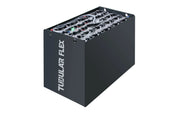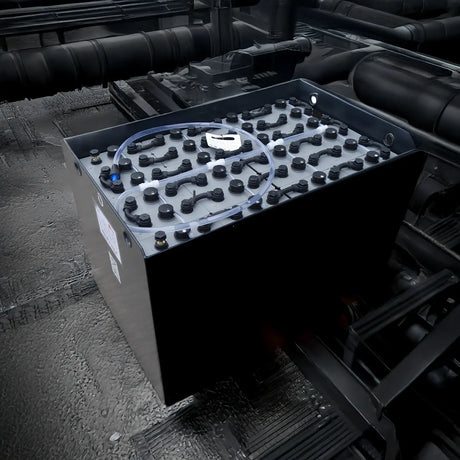

A forklift charging station is a workspace with clear safety requirements – not just a simple power connection. Depending on the battery type, charging can generate gases, electrical loads, and operational risks. Therefore, charging areas must be technically sound and organizationally clearly regulated.
What is a battery charging station for forklifts?
- Battery charging room: a separate room for charging and, if applicable, battery replacement.
- Charging zone: a designated area within the hall.
- Individual charging point: a defined charging spot for low demand.
Practical rule: The more forklifts charged simultaneously, the more a clearly defined charging area or dedicated charging room is required.
Requirements for room, floor, and structure
- Sizing: The charging area must be designed for the largest industrial truck used.
- Operating aisles: plan for at least 0.6 m of clear movement space around the charging point.
- Free accessibility: Chargers and shut-offs must be accessible at all times.
- Floor: level, non-slip, anti-static, and grease- and oil-free.
- No wet areas: Do not operate charging points in wet zones.
- Escape and rescue routes: must remain clear at all times.
- Separation from traffic routes: no danger from forklift traffic.
Ventilation and air exchange in practice
Ventilation must ensure an air exchange rate of at least 2.5 per hour. During charging – especially of lead-acid batteries – gases can be generated that must be safely exhausted.
- Natural ventilation: only suitable if continuously sufficient air exchange is guaranteed.
- Mechanical ventilation: required for enclosed spaces or high charging capacity.
- Planning: Design supply and exhaust air systems according to the state of the art.
- Important: Windows and doors are not considered a reliable sole ventilation solution, but only as a supplement.
Safety distances and clear zones
- Minimum 2.5 m distance to flammable materials.
- Minimum 5 m distance to areas at risk of fire or explosion.
- Minimum 10 m distance to welding, cutting, or metal grinding operations.
- No storage in the charging area – not even temporarily.
- No flammable materials above the charging point.
- No ignition sources in the vicinity.
Fire protection in the charging area
- Consistently enforce no-smoking policy.
- No open flames or sources of sparks.
- Provide fire extinguishers with at least 21 A extinguishing capacity.
- If a fire alarm or extinguishing system is present, 13 A is sufficient.
- Clearly define emergency measures.
Electrical safety and equipment
- Professional installation for continuous operation.
- Residual current protection according to the system.
- Consider explosion protection only where the risk assessment requires it.
- Appropriate protection class depending on the environment.
- Emergency stop or central shut-off in the charging area.
- No provisional extensions.
- Distance from charger to battery at least 1 m.
All components must match the battery technology and electrical design. Robust plug connections as well as suitable cable sets and end cables are prerequisites for safe operation.
Cable routing and mechanical protection
- Protect cables from being run over and crushed.
- No tripping hazards due to loose cables.
- Ensure strain relief.
- Immediately decommission damaged cables.
Battery types: Differences in operation
- Lead-acid: Gas formation possible → high requirements for ventilation and environment.
- Lithium: generally no classic gassing, but inherent risks and strict adherence to manufacturer specifications required.
Important: Lithium systems usually work with a Battery Management System (BMS), but this does not replace a safe environment or clear operating rules.
Operational organization
- Who is allowed to charge?
- Who checks chargers and cables?
- Who reports damage?
- Who locks off defective charging points?
- Who is responsible for maintenance and inspection?
Practical rule: Responsibilities must be clearly defined and documented.
Labeling and access rules
- Clearly mark the charging area.
- Warning sign: "Fire, open flames, and smoking prohibited".
- Warning sign: "Warning of hazards from battery".
- Establish access rules.
- Keep escape and rescue routes clear.
Employee training
- correct connection and disconnection
- handling of chargers
- identifying damage
- behavior in case of malfunctions
- fire protection rules
Inspection and maintenance in practice
- Regular visual inspection by users.
- Technical inspection by specialist personnel at fixed intervals.
- Inspection after damage before recommissioning.
- Documentation of all inspections and measures.
Practical rule: The more intensive the charging operation, the more frequent controls must be carried out.
Avoid typical errors
- missing ventilation
- storage in the charging area
- damaged cables in use
- unclear responsibilities
- missing labeling
Conclusion
Forklift battery charging stations are safety-critical workspaces. Crucial aspects include ventilation, safety distances, fire protection, electrical safety, and clear operational processes.
Anyone who consistently implements these requirements creates a safe and stable charging operation.